
Configuring Apache2 HTTPd Virtual Host to Work with Windows Server Internet Information Server (IIS) ASP.NET Hosting

Here's the tip I just discovered, compiled and tested on configuring an Apache2 virtual host to interoperate with Microsoft Internet Information Server ASP.NET hosting. My requirements and configuration are as follows:

  1. Operating System : Windows Server 2003
  2. Primary Web server : Apache2 on TCP port 80
  3. Web application server : Windows Server 2003 built-in Internet Information Server on TCP port 8090
The pictures below outline what need to be done.

1. Configure the virtual host name in the 'hosts' file or the DNS


2. Configure the IIS Web site to listen to TCP port 8090


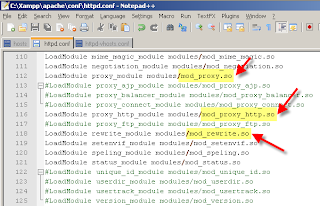
3. Enable the necessary Apache2 modules in the 'httpd.conf' file: mod_rewrite, mod_proxy, and mod_proxy_http (for HTTP interoperability).


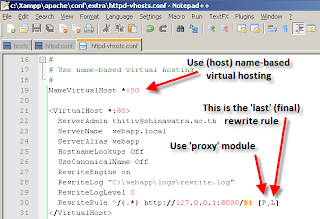
4. Configure the Apache2 virtual host settings in the 'httpd-vhosts.conf' file so that (i) name-based virtual hosting is enabled and (ii) all HTTP requests are 'proxied' to the IIS Web site on the same host (127.0.0.1) at the specified TCP port 8090. Note the "P" option for "proxy" and the "L" option which specifies 'no more' rewriting rules.


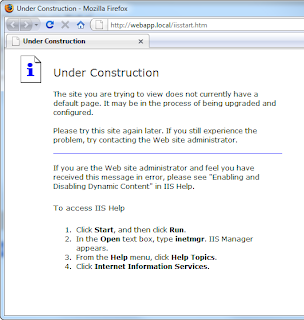
5. This is what it looks like on Firefox.
Comments

Jacky Chong said…
nice work...n useful info, though i'm not that pro

Popular posts from this blog

A Thought on a Reasoner-enabled Version of Del.icio.us (and perhaps Technorati)

I have been adding more bookmarks to my del.icio.us account and have begun tagging them with RDF-like object/datatype properties. Adding more and more object/datatype properties to the bookmark, a provoking thought popped up: It would be nice if tagging can be assisted by ontologies and a logic reasoner. Look at del.icio.us/thitiv . The _hasAffilication:CUPhoto property should be a subproperty of _hasAffiliation:Chula (provided that CUPhoto stands for Chula Photo Club .) Also, aticles on 'tagging' are subclass of articles on 'metadata'. But articles on 'metadata' are not essentially the articles on 'tagging'. 'Friends' versus 'people' is also another example. Bookmarks about my friends are of course bookmarks about people. But not all the people I know or found on the Internet (through search engines) are my friends. Ontology-assisted tagging sounds promising to solve this problem. In principle, this problem is partly related to...

Tips: Mac OS X: Full ANSI Color Support in Terminal.app

I'm trying to switch my Java development platform from Windows XP to Mac OS X Tiger. Wondering how to colorize the Terminal screen, I spent some time googling. From the discussions at the end of this page: macosxhints.com - Add full ANSI color support to Terminal.app Here's a summary of how to enable it: With bash shell as default, simply add export TERM=xterm-color [I prefer this for Linux compatibility] or export TERM=dtterm in the ~/.profile (single-user) or /etc/profile (system-wide) Color terminal is enabled. Use ' ls -G ' (the -G enables color output) to test. Add alias ls='ls -G' in the profile file for convenience. Keywords: mac-os-x , unix , terminal , shell , tips

Tip: Converting a CSV File into XML by Excel

I came across a problem to convert a historical data in comma-separated format (CSV) into a modern & more useful XML format. There are many ways to do such conversion. The most obvious one is to do it programmatically by writing a program to read CSV data and exporting it to an XML file by means of the Simple API for XML (SAX) or the Document Object Model (DOM) libraries. But I was too lazy to do it. I knew that Microsoft Excel 2003 supports exporting worksheets into XML data. I tried it out but found that it is not that simple -- we have to define an XML schema and bind each element to each column of the worksheet. So I went on researching. Finally, I found a very useful tool on MSDN: Excel 2003 XML Tools Add-in Version 1.1 ( download ). The Excel Add-in's "XML Tools -> Convert a Range to an XML List" menu command allows us to simply select a range in a worksheet (with or without first row as column names) -- with the advanced options to specify the XML root ...